VR09 keys
This text explains how to modify VR09 keys for ‘better grip’ (chapter (A) and how to add ‘key weights’ for a better responding action (chapter (B))
(A) VR09 key surface and shape
The keybed of VR09 is a special Roland design called ’rounded shape’ which means that the top of the black keys is not flat but slightly rounded and keys are narrower than standard piano keys.
While this key shape suites ‘thick finger’, other people have problems of slipping off the ’rounded surface’ or even missing the black keys.
The document explains how to fix this ‘black keys issue’ and also how to improve the ‘white keys’.
Sandpapering the black keys
This a. flattens the black keys ’round top surface’, b. adds ‘roughness’ for more finger grip and c. gives the black keys a look of ‘real piano’ keys with ‘ebony texture’.
Needed: sandpaper with ‘grain 80’, a wood block, scotch (some ‘light’, the one you use for painting windows ;)), vacuum cleaner
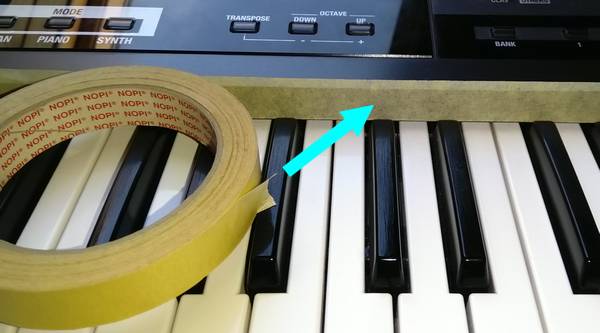
1. protect the fallboard with scotch against scratches (eventually also add a strip of scrotch on the white keys in front of the blacks):
2. stick sandpaper on a wood block
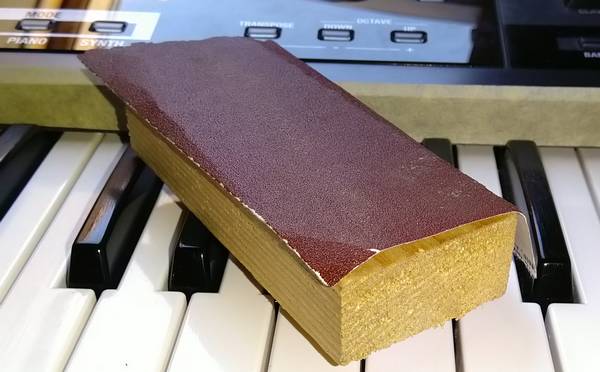
3. press block+paper with force on a couple of black keys and slowly move from rear to front: it’s like ‘scraping’ or ‘grating’. To make the round shape ‘flatter’ you can grind off up to 0.5 mm :
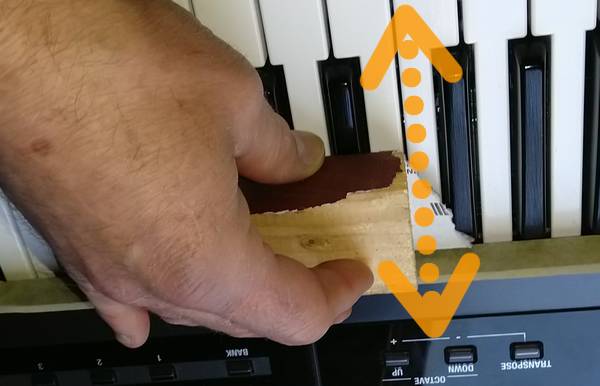
Check the result, repeat, work on other keys, check, repeat etc. When finished, use the vaccum cleaner to get out any debris between the keys and ‘out of the inner side’.
Acetoneing the white keys
The surface of the white keys can be improved by treating it with acetone
This a. makes the keys feel ‘warmer’ to the fingertips, b. gives the keys more gripp (especially for sweaty fingers) and c. gives the keys a nice ‘ivory (or marble) look’ (like pianos)
⇒ This mod must be done with care (!): start ‘slowly’, then increase ⇐
Soak a kitch paper towel with acteone and wipe off the keys carefully (in their lengthy direction): the acetone (slightly) dissolves the surface of the keys – the towel ‘smears’ a structure on the surface: it reminds some painting techniques !
At the beginning don’t apply too much acetone at once – start with a ‘little’ to get ‘a feel for the work’ – and make ‘pauses’ to give the key surface time to ‘recover’ and ‘reharden’: the key surface shall not be dissolved ‘too much’
Take care to not ‘dissolve’ the sidewalls of the black keys 🙂
When finished, don’t touch the key surface until it’s fully rehardened (after 1/2 hour)
The result
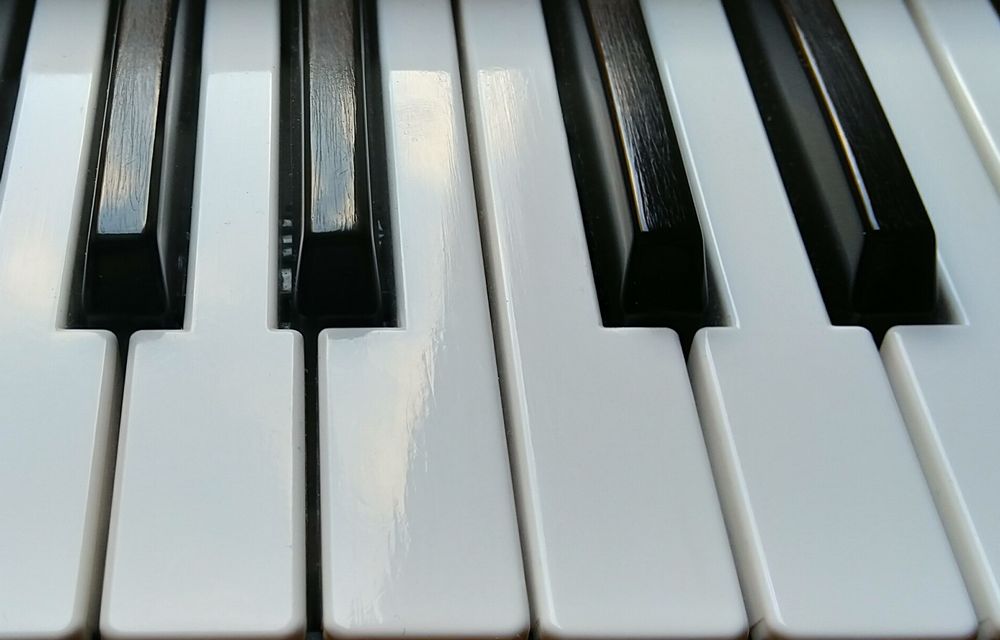
Black keys have ‘scratches’ against slipping off, the white keys have an ‘ivory texture’:
(B) Key weights
This mod adds key weights to each key: this reduces the down force (‘touch weight’), changes the ‘rebound behaviour’, adds ‘inertia’ to the keys – and slightly changes the noise of the keybed (to the dark side…)
First we analyse the down forces of the original keybed by stacking ‘motorcycle wheel rim balance weights’ or cent pieces on the front end of a key and measuring at which weight (in grams) ‘keybed actions’ happen:
| action | white | black |
| ‘let off’: key stops a little when it touches the contact rubber strip | 55 gr | 45 gr |
| note trigger for organ (quick fire) | 57 gr | 45 gr |
| note trigger for piano or synth | 67 gr | 71 gr |
Ca. 70 grams ‘down force’ for triggering a piano note is a lot – especially as the keys have no inertia that helps with acceleration. For sure this is ONE reason why the VR09 keybed is not very appreciated by players
To reduce the down force, tests were made with different weights added to black and white keys:
| weight | key | personal impression of the author |
| 10g | black | a good weight for black keys: 10g matches nicely with 5g on white keys |
| 5g | black | black keys improve but still feel ‘springy’ |
| 10g | white | down force and feeling of ‘accelerating’ a key is very nice for piano but the rebound is definitely too slow. The keys become too inert: don’t do this |
| 5g | white | nice feel for piano. Feels a little bit slower for synth sounds compared to original VR keybed. Rebound is ok. Rebound-noise gets a bit louder |
| 2.5g | white | barely any difference to original. |
| 2.5g | black | noticable change in ‘feel’ (in oposite to 2.5gr on white keys), keys feel more ‘substantial’ |
5g on white and 10g on black keys: nice for playing piano, EPs etc but feel a tiny (really tiny!) little bit slow for fast synth solos compared to the unweighted keybed
5g on both black+white keys: like the 5g/10g variant with black keys a bit more springy – this combination adds less weight to VR
To find your preferred choice of weights, do testing before irreversibly glueing weights : with (removable) duct tape, scotch weights in the keys of 2 octaves: each octave with different weights (e.g. one with 5g, one with 2.5g) to ‘feel the difference’. Play the keys also without sound to get the pure feel. Try with both hands.
When you’ve found your ‘personal weights’, open VR and remove the keybed as described in Open VR09.
Remove the keys (it’s quite easy): take the spring off and pull the key slightly to it’s front side.
If you remove-modify-remount ‘octave by octave’, you avoid a big pile of lose keys (BTW: there is NO NEED to note key numbers: every octave has the same set of key types).
Fixing the weights in the keys: ‘rim weights’ (see below) have a strong adhesive layer on their back side that should fix the weights for many years. Otherwise use epoxy glue. Don’t forget to de-grease (alcohol) the keys where the weights shall be placed.
Note that the total weight of the VR09 increases a little bit: ca 300 gramms with 61 x 5g weights, ca. 150 gramms with 61 x 2.5g weights
Maybe the easiest way is to buy a pack of ‘balance weights for motorcycle rims with adhesive tape’: cheap (ca 5 Euro/USD for 61 weights), easy to get (ebay) and easy to mount.
Our VR friends from France had an even more simplistic solution: steel nuts !
 |
5g + 2.5g lead weights |
 |
5g ‘coated steel’ weights (larger than lead weights) |
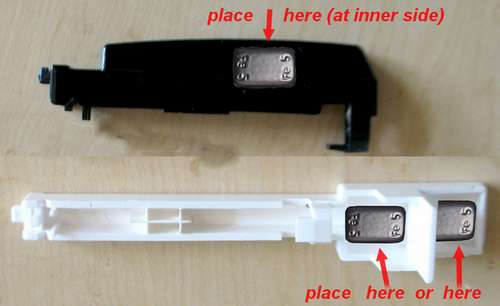 |
Placement of the weights. On the white keys, you have 2 possible positions. On the black keys, the smaller lead weights can be put in the front part of the key. The bigger steel weights must be placed more backwards or they’ll touch the key guide domes of the keybed frame |
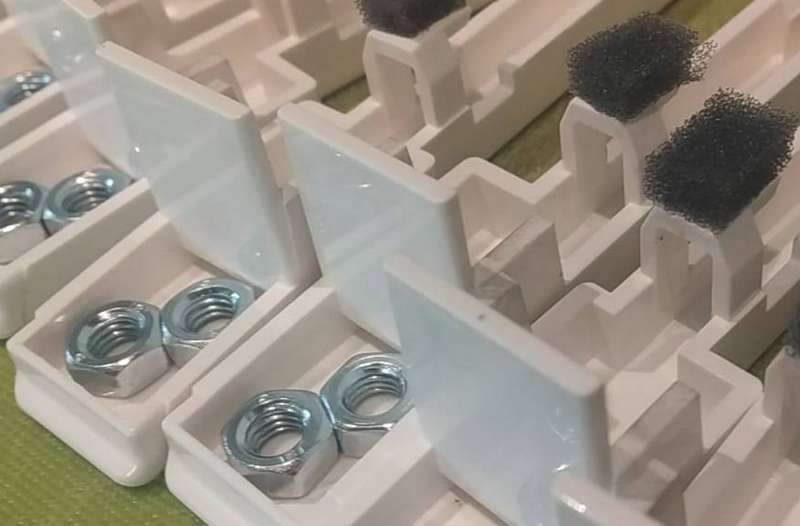 |
The solution of Aurelian |