Midi Keyboards for VR
Midi-Keyboards (Controllers) for ‘playing with VR09/VR730’
Midi keyboards can be used e.g. as ‘VR lower organ manual’, ‘piano sub-manual’ etc.
Basically ANY keyboard (digital piano, synthesizer etc) that is “sending midi” or dedicated ‘midi-controllers’ (keybaords without sound that only send midi) can be attached to VR as an additional manual
In the following we reference to them as “controller”
In the most basic ‘use case’, the controller just plays ‘notes’.
In more sophisticated applications, you might use the ‘pots and faders’ of the controller to modify VR sounds. Which kind of controller you need depends on to which extend you would like to ‘change VR parameters’.
NOTES:
– ‘Midi beginners’ who just want to ‘play notes’ are recommended to use the ‘simple setup’ described in next chapter.
– detailed info on VR and its ‘midi capabilities is given in VR AND MIDI and VR AND MIDI
– midi-controllers are usually connect to VR “MIDI IN” socket, using a “5-pin cable” (also called DIN-cable)
a special case is connecting a midi-controller to VR “PK IN” socket
Overview:
The first two chapters explain how VR is set up with a midi-controller. A1-B2 list controller models for VR:
Controller setup VR “Midi-Modes”
The midi-controller and its ‘controllers’ (keys, faders, pots etc)
(A1) Controllers with standard key-size and ‘Roland SysEx’
(A2) Controllers with standard key-size but without ‘Roland SysEx’
(B1) Controllers with ‘mini-keys’ and ‘5-pin/TRS’ midi-out and ‘SysEx’
(B2) Controllers with ‘mini-keys’ and ‘5-pin/TRS’ midi-out (all models)
Controller setup and VR “Midi-Modes”
When attaching a controller one must select an appropriate VR “Midi Mode”. It’s a setting in VR menu ‘MIDI’ and determins the way the controller interacts with VR.
- The simple setup: VR in “KEYBOARD”-mode ↠ controller as ‘lower manual’
VR provides an easy option for connecting a controller without ‘diving into midi – world’: the ‘KEYBOARD’ mode
>> KEYBOARD mode is suited to ‘organ players’ and ‘midi non-experts’ <<
In KEBYOARD mode, VR + controller work together like a real “2-manual-organ” (Roland VK88/Atelier, Nord C2 etc):
1. connect the controller to VR ‘MIDI IN’ jack with a 5-pin midi cable
2. eventually activate ‘midi send’ on the controller
3. go into VR menu MIDI, scroll to option MIDI IN Mode and set to KEYBOARD
4. on VR set “SPLIT” (Organ split or 2 patches in a split): the ‘L’-sound is assigned to the controller (lower manual)
Notes: in KEYBOARD mode:
→ VR receives on any midi channel: the controller does not need to send on a specific channel
→ you cannot split VR keybed itself: any SPLIT is assigned to VR keybed as upper and controller as lower manual
→ you can use Classic Midi Control Changes and V-Combo EDITOR - The advanced setup: VR in “Mode 2” ↠ controller to control VR ‘zones’ and GM2-engine
This setting gives more flexibility to the controller (e.g. playing VR organ bass, VR hidden zones, etc)
1. connect the controller to VR ‘MIDI IN’ jack with a 5-pin midi cable
2. go into VR menu MIDI, scroll to option MIDI IN Mode and set to MODE 2
3. on the controller set the midi channel corresponding to VR lower/solo/bass manual or ‘GM2 engine” as listed in VR MIDI TX and RX channels
Notes: in MODE-2 mode:
→ you can use Classic Midi Control Changes and V-Combo EDITOR - The GM2 setup: VR in “Mode 1” ↠ controller to control exclusively VR GM2-engine
1. connect the controller to VR ‘MIDI IN’ jack with a 5-pin midi cable
2. go into VR menu MIDI, scroll to option MIDI IN Mode and set to MODE 1
3. now set the appropriate midi TX channel 1-16 on the controller to engange a VR ‘GM2 engine” channel
Notes: in MODE-1 mode:
→ you can use Classic Midi Control Changes BUT NOT V-Combo EDITOR
→ there is no risk to accidentially ‘interfere’ with VR keyboard sounds
→ to use the controller both for VR Keyboard and GM2-engine select Mode-2
The midi-controller and its ‘controllers’ (keys, faders, pots etc)
Every ‘mechanical unit’ of a midi-controller is (also) called ‘controller’ (it’s a bit ambigious): a key is a ‘note controller’, faders and pots are ‘controllers for e.g. filter, volume etc’.
- The very simple case: controller to play ‘lower manual’
If you want just ‘play notes’ on ‘lower manual’, set VR to Midi-Mode ‘KEYBOARD’ as explained in previous chapter and … play - The more sophisticated case: using controllers of the controller for ‘classic midi’
VR accepts many ‘classic midi’ Control Changes (pitch, mod, volume, filter, envelope etc).
You can use the faders/knobs of the midi-controller with these Control-Changes to modify sounds on VR:
Complete list of VR Control Changes: List of ‘classic midi signals’ of VR
The way, Control Changes act on VR depends on VR ‘Midi-Mode’:
In Midi-Mode ‘KEYBOARD’, CCs are applied to the sound(s) in lower manual (with exception ‘Expression’, see below)
In Midi-Mode ‘MODE-2’, CCs are applied to the sound(s) in the target VR zone or GM-engine Channel
In Midi-Mode ‘MODE-1’, CCs are applied to the sound in the target GM-engine Channel
Notes:
→ ‘Expression’ (CC11) is applied ‘VR-wide’: connecting the expression pedal to the midi-controller
instead VR ‘expression-in’ is a simple way to resolve the VR Expression Pedal Bug
→ Note that the Control Changes differe for VR ‘keyboard sounds’ and VR ‘GM2-engine’ - The most complex case: you want to use the controllers pots/faders e.g. as ‘lower organ drawbars’
You’re at the doorstep to ‘ugly SysEx’ …
Most VR parameters like ‘VR drawbars’ can only be changed by SysEx. So the controller must be capable to send ‘Roland SysEx midi’ – and you have to dive into sysex world (by studying the ‘VR09/730 midi implementation manual’ provided on Roland website
‘SysEx’ capable midi-controllers are listed in chapter (A1) and (B1)
Notes:
→ to receive SysEx, VR must be in Midi-Mode ‘KEYBOARD’ or ‘MODE-2’ (in MODE-1 VR does not receive SysEx)
(A1) Controllers with standard key-size and ‘Roland SysEx’
Only very few ‘old’ (2nd hand) controllers are capable to send SysEx-Midi for controlling VR parameters like ‘organ drawbars’:
Roland A-Pro series
Edirol PCR x00 series
Novation Remote SL series with models SL-Mk1, SL-Mk2 and SL-Compact (not SL Mk3!)
There are no new ‘SysEx-capable’ controllers anymore (‘new old stock’ Roland A-Pro still might be found)
Main differences of the controllers:
Roland A-Pro vs. Edirol PCR: : Edirol was a subbrand of Roland (‘Edition Roland Corporation’) and PCRs are the forerunners of A-Pro. Both are very similiar. ‘Key action’ is slightly different (light synth actions with too short keys but A-Pro has VR09 style ’rounded keys’ while Edirol keys are edged). Pads are different and A-Pro requires an editor for programming most parameters while PCRs can be fully programmed on the board.
Roland/Edirol vs. Novation Remote: Fundamental difference is the ‘key action’ : Novations use a semiweighted (with added key weights) Fatar TP/9S – which has totally different (superior) feel compared to Roland/Edirol. More differences are the controllers, the pitch/mod device etc.
Which one to chose, Roland, Edirol or Novation?
This should help to balance your preferences:
Controller as VR organ lower manual: A-Pro and Edriol. Both have 9 faders for lower drawbars. With VR09 both actions allow to have an ‘equal feel’ on upper/lower manual. A-Pro keys are even identical to VR09 keys: if you have problems with VR09 slippery ’rounded’ black keys, consider Edirol. Novations are less suited for ‘organ’ with only 8 faders with ‘flat caps’ and distance to each other
Controller as VR piano/EP sub manual: This is the big point of the Novations with their excellent semiweighted Fatar TP/9S action (which of course also works for organ playing)
Controller for deep VR midi control:: For total control of VR including ‘VA synth parameters’ or ‘Juno-G hidden functions’, A-Pro and Edirol are mandatory. Novations, due to limited SysEx lenght, can control all VR ‘base parameters’ (like drawbars, MFX etc) but SysEx is too short for VA-synth or Juno-G layer)
Editors (for PC/Mac): Roland/Edirol editors are nicely made and cover most/all keyboard features. Novation is a bit complicated: the official editors are missing basic functions (like sysex config), ‘EdiSyn’ freeware editor is much better but also has some ‘bugs’ – at worst a few parameters must be programmed on the controller itself.
A collection of all Novation editors can be found here: Novation editors
Decision matrix:
| . desired feature: |
Remote SL Mk1/Mk2 |
Remote SL Compact |
Edirol PCR x00 |
Roland A-Pro x00 |
| ‘best organ drawbars’ | o | o | + | + |
| action ‘like VR09’ – 2 equally feeling manuals | – | – | o | + |
| action ‘like VR09’ but ‘less slippery’ | – | – | + | – |
| premium action for playing piano and EPs | + | + | – | – |
| ‘decent pads’ (suitable for finger drumming) | – | – | – | + |
| pitch/mod ‘Wheels’ | – | + | – | – |
| full controller info shown in display | + | + | – | – |
| flexible zones (layers, splits, overlaps, velocity …) | + | + | – | – |
| Full control of extended VR parameters like VA-Synth | – | – | + | + |
The Controllers in details
All controllers are usb-midi class compilant: no need for proprietary drivers on newer OSX/Windows (on Edriols, Roland native driver must must be disabled by “Advanced Driver Switch”, see manuals and Roland support sites)
- Roland A-Pro A300/A500/A800: keys (2nd hand / NOS)
Roland successor or the Edirol Series. The action is identical to VR09, ‘deeper’ parameter editing requires the editor 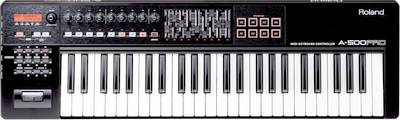
- versions: 32/49/61 keys. Light synth action with Aftertouch, keys like VR09 (identical ’rounded’ key shape, slighly different touch)
- 2 Zones (split/layer)
- 9 faders (drawbars!), 9 pots, 13 buttons, 8 (modern and reactive) pads with velocity sensitivity and Aftertouch (!)
- SysEx: maximal message length (complete string F0..F7 with data bytes and checksum): 24 byte
5 ‘data variable types’ (1x7bit, 2x7bit, 2x4bit etc), Roland Checksum and ‘custom checksum’ - programming: basic settings can be set on the device, deeper parameters only by editor (PC, Mac)
- Roland-Edirol PCR 300/500/800 (2007) (2nd hand)
This is the most recent and best Edirol series. It’s midi capabilties are identical to A-Pro but with more controllers 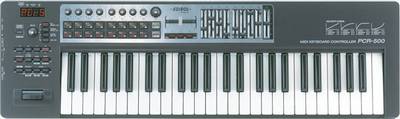
- versions: 32/49/61 keys. Light synth action with Aftertouch, short keys like VR09/A-Pro but nicer shape
- 2 Zones (split/layer)
- 9 faders (drawbars!), 9 pots, 7 buttons, 18 “mini-pads” with velocity sensitivity and Aftertouch (!)
- SysEx: maximal message length (complete string F0..F7 with data bytes and checksum): 24 byte
5 ‘data variable types’ (1x7bit, 2x7bit, 2x4bit etc), Roland Checksum and ‘custom checksum’ - programming: ALL settings can be set on the device OR done by editor (PC, Mac)
- Roland-Edirol PCR M30/M50/M80 (2005) and PCR 30/50/80 (2002) (2nd hand)
Older Edirol Series. Not recommended: keyboard contacts are know for wear (repairable with graphite), only 8 faders, only 1 zone - versions: 32/49/61 keys. Light synth action with Aftertouch. Action is kown for wear
- only 1 zone
- 8 faders (drawbars), 8 pot, no pads
- programming: ALL settings must be set on the device (no editor available)
- Novation Remote SL Mk2 25/49/61 (2009) (2nd hand)
Mark-2 is very similiar to Mark-1: Mk2 has LEDs around the endless encoders and LED light buttons but only 1 display bar
Note that newer SL Mk3 and later DO NOT HANDLE SYSEX!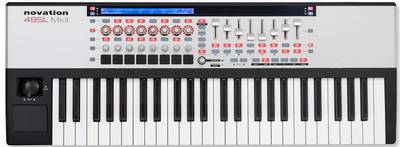
- versions: 25/49/61 keys, semiweighted action Fatar TP/9 (with Aftertouch), excellent for piano
- 4 Zones with velocity ranges
- 8 pots + 8 endless pots, 8 faders, 32 buttons, 8 ‘mini-pads’ — no ‘banks’ for controllers
- 1 ‘long display bar’ showing a customisable name for each pot/button
- SysEx: maximal message length (complete string F0..F7 with one/two ‘data bytes’ and checksum): 16/17 byte
2 ‘data variable types’ (1x7bit, 2x7bit), Roland Checksum - programming: ALL settings can be set on the device OR done by Novation editor (PC, Mac) or 3rd party editor ‘EdiSyn’ (see collection of Editors)
- Novation Remote SL (Mk1) 25/37/61 (2007) (2nd hand)
The first of the Remote SL Series 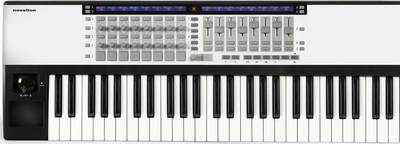
- versions: 25/37/61 keys, semiweighted action Fatar TP/9 (with Aftertouch), excellent for piano
- 4 Zones with velocity ranges
- 8 pots + 8 endless pots, 8 faders, 32 buttons, 8 ‘mini-pads’ — no ‘banks’ for controllers
- 2 ‘long display bars’ showing a customisable name for each pot/button/fader
- SysEx: maximal message length (complete string F0..F7 with one/two ‘data bytes’ and checksum): 16/17 byte
2 ‘data variable types’ (1x7bit, 2x7bit), Roland Checksum - programming: ALL settings can be set on the device OR done by Novation editor (PC, Mac) or 3rd party editor ‘EdiSyn’ (see collection of Editors)
- Novation Remote SL COMPACT 25/49 (2007) (2nd hand)
Compact is an (less pricey) alteration of SL Mk1/Mk2: no faders, no xy-trackpad, less pots/buttons, bigger pads, pitch/mod wheel instead of joystick 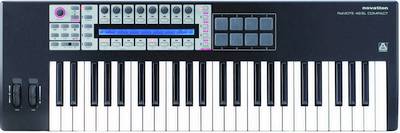
- versions: 25/49 keys, semiweighted action Fatar TP/9 (with Aftertouch), excellent for piano
- 4 Zones with velocity ranges
- 8 endless pots (x4 banks), 8 buttons (x4 banks), 8 ‘real’ pads (less responsive than A-Pro)
- 1 ‘long display bar’ showing a customisable name for each pot/button
- SysEx: maximal message length (complete string F0..F7 with one/two ‘data bytes’ and checksum): 16/17 byte
2 ‘data variable types’ (1x7bit, 2x7bit), Roland Checksum - programming: ALL settings can be set on the device OR done by Novation editor (PC, Mac) or 3rd party editor ‘EdiSyn’ (see collection of Editors)
Novation Remote SL vs A-Pro vs. Edirol:
| Remote SL Mk1/Mk2 | Remote SL Compact | Edirol PCR x00 | A-Pro x00 |
| + Fatar TP/09 semiw. | + Fatar TP/09 semiw. | o not so bad Roland | – bad Roland (like VR09) |
| + 4 Zones | + 4 Zones | o 2 Zones (split/dual) | o 2 Zones (split/dual) |
| + 32 Buttons (1 bank) | o 8 Buttons (x4 banks) | o 7 Buttons (1 bank) | + 13 Buttons (1 bank) |
| + 16 Pots (1 bank) | o 8 Pots (x4 banks) | o 9 Pots (1 bank) | 9 Pots (1 bank) |
| o 8 Faders (1 bank) | — | + 9 Faders (1 bank) | + 9 Faders (1 bank) |
| – 8 mini-Pads (1 bank) | o 8 Pads (1 bank) | o 18 mini-Pads with AT (1 bank) | + 8 ‘real’ Pads with AT (1 bank) |
| + 32 user presets | + 32 user presets | o 19 user presets | o 19 user presets |
| pitch/mod joystick | pitch/mod wheels | pitch/mod joystick | pitch/mod joystick |
| + xy-pad | |||
| + large display(s) with customisable controller names | + large display with customisable controller names | – minimalistic display | – minimalistic display |
| o sysex limited to VR keyboard parameters | o sysex limited to VR keyboard parameters | + sysex for all VR parameters | + sysex for all VR parameters |
| programming on device: + easy with large display(s) |
programming on device: + easy with large display |
programming on device: – fiddely with mini-display |
programming on device: – only few parameters |
| programming with editor: – fiddely with 2 buggy editors |
programming with editor: – fiddely with 2 buggy editors |
programming with editor: o nice editor (does not cover all parameters) |
programming with editor: o nice editor (does not cover all parameters) |
| all sockets on the rear side | all sockets on the rear side | all sockets on the left side | all sockets on the left side |
(A2) Controllers with standard key-size but without ‘Roland SysEx’
There’s an infite number of available controllers, new ones, old ones … so we don’t list them here.
The only ‘technical requirement’ on the devices is ‘real’ midi-sockets (5-pin). Modern (DAW-)controllers with only ‘usb-midi’ cannot directly be attached to VR midi-in (VR won’t recognise it)
(B1) Mini-Key Controllers with DIN (or TRS) Midi out and ‘SysEx’
There is actually only one mini-controller that is able to send SysEx messages, the M-Vave SMK37 Pro/Elite:
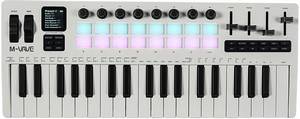 |
⇒ for all functions of SMK 37, see Chapter (B2) ⇐ |
Important: SMK can send sysex only as a ‘fixed value’ message but not as ‘continous controller’:
– it cannot be used for ‘continous controllers’ like ‘VR drawbars’ or ‘VR EFX knobs’ (e.g. amount of Overdrive)
– it can be used to send ‘fixed values’, like ‘select a MFX’, set organ functions like V/C and percusssion type – or even load ‘hidden GM/GS/SC sounds’
For sending sysex, SMK pads have to programmed with option ‘Custom’ (via SMK editor ‘MidiSuite’ from ‘www.cuvave.com’, Download => PC-Software)
How to obtain the sysex messages? Two methods:
a. connect VR to a midi-monitor app (free apps: ‘Mios-Studio’ (Windows), “Midi View” (Windows, Mac), “Midi Monitor” (Mac)
engange a VR button or ‘menu option’ (like V/C type), copy the ‘sysex string’ shown in the Monitor to a SMK pad
b. use ‘CTRLR EDITOR’: open monitor with PC-shortcut “ctrl + M’, in ‘View’ activate red ‘ouput’ and ‘Show RAW data’
switch a ‘button’ (dropdown etc) on EDITOR, copy the ‘sysex string’ shown in CTRLR Monitor to the SMK editor
Examples:
- To switch to organ Chorus ‘C-1’, connect VR to the Midi-monitor, in VR V/C menu, select type ‘C-1’ and copy the sysex string from monitor to an ‘SMK pad’ (e.g. the sysex for C1 is “f0 41 10 62 12 00 00 38 03 45 f7”)
- To get the sysex of a ‘hidden GM/GS/SC’ sound, use CTRLR Editor (use CTRLR monitor as explained before):
In panel SOUND-GM2 set engine to ‘[KBD]’, ‘activate’ a voice and load a GM/GS/SC patch to the voice, then copy the ‘bank program change’ (the ‘longest string’ with the ’06’ byte) shown in CTRLR monitor to a SMK pad
(N.B. you must also save the regisation with the ‘activated’ voice to VR)
Example: patch ‘Coupled Hps.’ from GS/SC Clav: “f0 41 10 00 00 71 12 18 00 28 06 08 00 06 2c f7″
NOTE: the ‘sysex string’ in a SMK pad ‘Custom field’ can be up to 32 bytes, that means you can also ‘chain’ several sysex messages.
Example of a ’22 bytes’ message: the first sysex (f0 41 10 62 12 00 00 5d 09 1a f7) sets MFX to ‘Modulation D’, the second (f0 41 10 62 12 00 00 5e 40 62 f7) sets MFX amount (‘the Vr knob’) to ’64’ (hex 40):
f0 41 10 62 12 00 00 5d 09 1a f7 f0 41 10 62 12 00 00 5e 40 62 f7
(B2) Mini-Key Controllers with DIN (or TRS) Midi out
‘mini-key’-controllers are designed for handling virtual instruments and DAWs on computers/tablets – therefore most have only a ‘usb-midi’ connection, no ‘real midi-outs’.
“usb-midi” cannot directly be attached from the controller to VR (VR won’t recognise it). usb-midi into VR could only be used via an intermediate computer/tablet (acting as ‘usb-host’ between the two ‘usb-clients’, controller and VR).
Luckily a handfull of mini-keys have additional ‘real-Midi’ sockets which allow direct connection to VR midi-in. These midi-sockets are either classic ‘5-pin’ or ‘3.5mm TRS’ jacks. In case of ‘TRS’ you need a ‘TRS-adapter-cable to 5-pin midi’. TRS-Midi-adapters can have different ‘standards’, the most common is type-A, fewer are type-B or type-C. The type is mentioned in the list of boards
Buyers ‘considerations’:
- number of keys: 25 keys (2 octaves) is hardly usable for ‘live playing’, 32 a significant improvment, 37 keys is a huge difference
- keybed: ‘springs’ vs. ‘plastic hinge’: ‘real springs’ are much more endurable than keys with ‘plastic hinges’ which are prone to break
- individual channels for each controller give more flexibilty to control VR functions (CCs on different VR parts/manuals).
- expression-pedal input: an expression pedal socket can solve the “VR expression pedal bug” (no ‘soldering pedals’ or adding ‘midi pedal converters’ ..)
- bank + program change: if you want to use the controller eg. for playing VR ‘GM engine sounds’ it must be capable of sending Bank+PC for loading GM sounds: ideally bank+PC can be set in one controller (MVave, M-Audio, Arturia), if not, you need to program 3 controllers (2 x CC for bank msb/lsb, one for PC) to recall a patch
- user-presets: how many ‘user-presets’ for being used with different ‘devices’ (non only VR but others synths or a DAW)
Overview (prices in Europe):
- M-Vave SMK 37 Pro/Elite (70/100 €): maybe the perfect ‘mini-controller’ for VR: 37 keys, expression pedal jack, SysEx capable, onboard DX7 “FM engine”, Step Sequencer
- M-Vave SMK 25 I/II (60-70 €): well suited for live usage, good controllers, 25 keys,
- M-Audio Oxygen Pro Mini (110 €): well suited for live usage, good controllers, 32 keys
- Arturia Minilab-3 (95 €) : well suited for live usage, easy handling, good controllers, only 25 keys
- M-Vave SMK mini/Swissonic p25 (50 €): minmalistic, simplistic and cheap key for ‘just playing notes’
- Miditech i2-mini 32 plus(55 €): simplistic and cheap key for ‘just playing notes’
- MidiPlus X2/X3/X4/X6 mini (90-130 €): simplistic and durable key for ‘just playing notes’
- Behringer Swing / Arturia Keystep (55/140 €): no controllers but sequencer
- Donner MP 25 Pro (110 €): ultra-flat, ok for live usage, good controllers
- WORLDE Panda Mini 2 / Miditech Garagekey Groove-2/PAD (70 €): ok for live usage, good controllers
- Novation Launchkey Mini MK3/Mk4 (100 – 160 €): focused on Ableton which reduces versatility
- IK Multimedia IRig Keys 2 mini (100 €): small and simple – but fragile for live usage
- AKAI Professional MPK mini Plus (170 €): 37 keys, sequencer, but limitations on midi and channel settings
| keys | keybed quality |
build quality |
ease of use |
user presets |
bank program |
controllers | arpeggiator | sequencer | ‘bargain’ | model |
| 37 | + | + | + | ++ | ++ | +++ | + | + | ++ | M-Vave SMK 37 pro/elite |
| 32 | + | + | o | +++ | ++ | ++ | + | M-Audio Oxygen Mini Pro | ||
| 37 | + | + | + | ++ | ++ | ++ | + | + | M-Vave SMK 25 I/II | |
| 25 | + | + | + | + | ++ | ++ | + | Arturia Minilab-3 | ||
| 32 | o | o | ++ | o | + | + | Miditech i2 32 mini plus | |||
| 25 | o | o | + | + | o | ++ | + | + | Miditech Garagekey/ Worlde | |
| 25 | ++ | ++ | ++ | o | MidiPlus mini | |||||
| 37 | + | + | + | ++ | o | o | + | + | Akai MPK 37 Pro | |
| 32 | + | + | ++ | ? | + | + | ++ | Behringer Swing |
(+++ exceptional / ++: very good / +: good / o: mediocre / ‘blank’: not available)
The Controllers in details
- M-Vave SMK 37 Pro “controller + DX7 emu” (ca. 70 € on aliexpress – wait+watch for offers)
The M-Vave SMK Pro is a new, exiting controller from ‘Cuvave’ with onboard Yahama DX7 emulator (!) and 37 keys (3 octaves). User panel is well organised with a display that deserves its name. The SMK37 is full of features: Bluetooth Midi+Audio, Sequencer, Arpeggiator, Chord/Scale function, ‘pedal-in’ for sustain and expression pedal – and a DX7 engine for replaying original or custom DX7 patches, or even self created on Dexed-VST …) and basic effects.
The SMK37 is highly flexible with many midi-options, including bank+Program-Change and even SysEx
Several colours (standard, white, red, pink, ‘black keys’). The new SMK37 ‘Elite’ model has FL-Studio integration and an ‘improved action’
- Dimensions/Weight (cm/kg): 45-18-5/1.1
- 37 mini-keys (width: 19.4mm, length 80mm): decent action (‘real spring mechanics’)
- TRS-Midi (needs a “Type A” adapter to 5-pin DIN)
- BT-Midi (usable with Midi-Kit ‘M-Vave MS-1’ to connect to VR)
- expression pedal jack (e.g. for fixing VR expression pedal bug)
- inbuild Battery (recharable)
- 8 user-presets
- 2 banks of 4 faders, 2 banks of 8 pots, 2 banks of 16 pads (with poly AT)
- individual channel assign to ‘keybed’, pads, faders, pots (Arp and Sequencer run on ‘keybed channel’)
- controller midi-options: faders: CC / pots: CC,AT / pads: notes,CC,bank+PC,’custom’ (up to 32 bytes constant value message string of SysEx, CC etc !)
- programming: DX7-engine on device, basic settings on device, midi-controllers by editor (PC/Mac)
- pitch/mod ‘wheels’
- Arpeggiator, Sequencer (8 patterns a 62 steps), Chord/Scale function
- “DX7 engine” (real FM-engine) + effects + basic sound tweaking (e.g. changing FM algorithms), 4 ‘DX’ banks with each 32 patches corresponding to DX7 ‘roms’
- Audio-Interface via usb (bidirectional) and BT (from device to SMK, e.g. for backing tracks): while the DX7-engine is mono, the audio-interace is stereo
- No 3rd party Software included
- CON: neither Arp nor Sequencer have (in or out) ‘clock sync’ (Arp has a sync switch but it’s buggy – hopefully fixed in a later firmware)
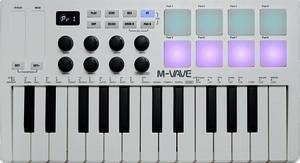
- M-Vave SMK 25 I/II (ca. 60 € on aliexpress – wait+watch for offers)
M-Vave SMK 25 I/II differe in the panel design (features are more/less identical) 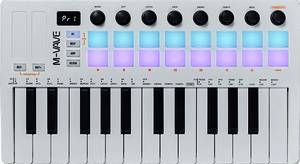
- Dimensions/Weight (cm/kg): 32-18-5/0.8
- 25 mini-keys (width: 19.4mm, length 80mm): decent action (‘real spring mechanics’)
- TRS-Midi (‘double function’ of sustain-jack, needs a “Type A” adapter to 5-pin DIN)
- BT-Midi (usable with Midi-Kit ‘M-Vave MS-1’ to connect to VR)
- inbuild Battery (recharable)
- 8 user-presets
- 8 pots, 8/16 pads (with poly AT), MCP (Mackie Transport Control) for controlling DAWs
- individual channel assign to ‘keybed’, pads, pots (Arp runs on ‘keybed channel’)
- controller midi-options: pots: CC,AT / pads: notes,CC,bank+PC
- programming: basic settings on device, specific by editor (PC/Mac)
- pitch/mod ‘touch strips’
- Arpeggiator, Chord/Scale function
- No 3rd party Software included
- M-Audio Oxygen Pro Mini (ca. 110 € + TRS-midi adapter)
The Oxygen is a solid design – and 32 keys make a difference to 25. User interface is a little bit ‘confusing’, but the board offers more options than any other (e.g. playing a chord on one VR-GM-channel while the Arpeggiator runs into another VR-GM-channel). M-Audio is maybe the most flexible and ‘best adapted’ controller for VR 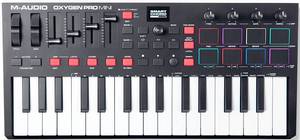
- Dimensions/Weight (cm/kg): 40-19-6/1.2
- 32 mini-keys (width: 19.4mm, length 80.4mm): good and sturdy action (‘real spring mechanics’)
- TRS-Midi (needs a “Type A” adapter to 5-pin) with Midi-Thru option
- 14 user-presets + 1 “DAW”-preset
- 2 banks of 4 faders, 4 pots, 4 buttons and 8 pads
- individual channel assign to ‘keybed’, pads, faders, pots, buttons, Arpeggiator
- controller midi-options: faders+pots: CC / buttons+pads: CC,Note,bank/program-change (msb/lsb/pc)
- programming: ALL settings can be set on the device OR by editor (PC, Mac)
- pitch/mod ‘wheels’
- Arpeggiator (receives clock sync) and Chord function
- Included software: Ableton Live Lite, Akai MPC Beats, Hybrid-3 virtual synth
- CON: at least one ‘production batch’ with buggy TRS-out (sending ‘message bursts’ every 20 seconds)
- Arturia Minilab-3 (Mark 3) (ca. 95 €)
French elegance: several colours options (alpine white, green…) and wood side panels. Pads have Aftertouch. ‘real’ 5pin midi. The ‘user interface’ is more evident compared to M-Audio but the board offers less options. 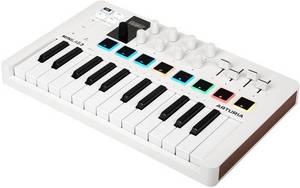
- Dimensions/Weight (cm/kg): 35-22-5/1.5
- 25 mini-keys (width: 20.6mm, length 88.6mm): a good and sturdy action (‘real spring mechanics’)
- 5-pin-midi out with Midi-Thru-option
- 5 user-presets (easy switching with SHIFT + pad-3)
- 1 bank of 8 pots, 4 faders and 2 banks of 8 pads. Pads have Aftertouch (!)
- easy changing of (global) channel (press SHIFT + a key with channel number)
- individual channel assign to ‘keybed’, pads, faders, pots
- controller midi-options: faders+pots: CC,NRPM / pads: CC,notes,bank/program change (msb/lsb/pc)
- programming: basics can be set on the device, deeper editing with editor (PC, Mac)
- pitch/mod ‘touch strips’
- Arpeggiator and Chord function
- Included software: Ableton Live Lite, Arturia “Analog-Lab” (500 samples), UVI-Steinway-D, NI-Upright
- M-Vave SMK mini / Swisswonic P25 (ca. 50 €)
Maybe the most simplistic and cheapest solution for ‘just playing notes on VR” – and it’s battery powered – like VR 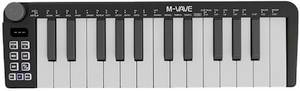
- Dimensions/Weight (cm/kg): 35-11-5/0.6
- 25 mini-keys
- TRS-Midi (‘double function’ of sustain-jack, needs a “Type A” adapter to 5-pin)
- BT-Midi (usable with Midi-Kit ‘M-Vave MS-1’ to connect to VR)
- inbuild battery (recharable)
- no presets – just the momentary setting
- programming: Editor
- One (big) encoder
- Arpeggiator and Chord function
- Miditech i2-mini 32 PLUS (ca. 55 €)
Simplistic and cheap solution for ‘just playing notes on VR” – and it’s battery powered – like VR. Board is larger than other ‘minis’ (50cm) 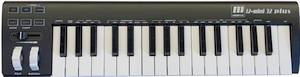
- Dimensions/Weight (cm/kg): 49-13-5/0.7
- 32 mini-keys (width: 20.0mm length 80mm)
- TRS-Midi (adapter included)
- Battery (4x AA) and usb-powered
- no presets – just the momentary setting
- programming: ALL settings must be set on the device (no editor)
- pitch/mod touch-wheels
- Arpeggiator and Chord function
- Included software (with ‘MidiTech’): Miditech Free Software Bundle (VSTs, Samplers, Drum Computer etc)
- MidiPlus X2/X3/X4/X6 mini (ca. 90/100/110/130 €)
Maybe the most simplistic and durable solution for ‘just playing notes’ + few Control-Change pots: metal housing, very good keys, easy user interface – available from 25 to 61 keys
(There exist also ‘mini pro’ versions with 49 or 61 keys, more pots, pads etc)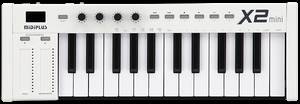
- Dimensions/Weight (cm/kg): 41-14-5/1.7 (x2) … 85-14-5/3.2 (x6)
- 25/37/49/61 mini-keys (width: ?? length ??): one of the best mini key actions
- 5-pin-Midi
- no presets – just the momentary setting
- 4 pots, 6 buttons (‘transport’ buttons can be used to send Control Changes)
- individual channel assign to ‘pots’
- controller midi-options: pots/buttons: CC
- programming: ALL settings must be set on the device (no editor)
- pitch/mod touch-strips
- Included software: Ableton Live Lite, Akai MPC Beats, Hybrid-3 virtual synth
- Behringer Swing / Arturia Keystep (55/140 €)
The Swing is a ‘clone’ of the Keystep but less than half price, so we mention it first. There are no controllers (faders,pots,pads) but Arpeggiator, Sequencer and ‘CV-outs’ for controlling analog synths
Main difference between Swing and Keystep is that Keysteps includes the Arturia Software Sound world
‘Keystep 37’ has more keys and 4 pots
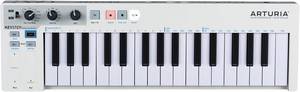
- Dimensions/Weight (cm/kg): 49-15-4/1.4
- 32 mini-keys (width: 22mm, length 95mm)
- 5-Pin-midi out and in
- no user-presets
- programming: settings can be set on the device. Arturia provides an editor (PC, Mac), eg. editing sequences ‘live’ while playing
- pitch/mod touch strips
- Step Sequencer, Arpeggiator, Chord function
- Included software: Behringer : – Arturia: Editor, Arturua Soundpacks
- Donner MP 25 Pro ‘midi-out’-version (ca. 110 € + TRS-midi adapter)
‘pure fashion’: outstanding design, 3 colour options, superflat (2.6 cm !). Easy user interface.
Cannot send ‘program change’ (which might not bother if you don’t use VR GM2 sounds)
Attention: exists in 2 versions with the same name: 1. midi-out jack 2. sustain-pedal jack
the ‘midi-version’ has “SUSTAIN” written below the [K/S-BANK] buttons while ‘sustain-pedal-version’ has “LATCH”)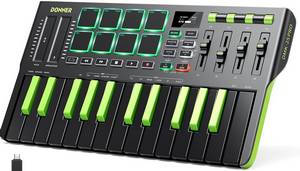
- Dimensions/Weight (cm/kg): 34-18-2.6/0.7
- 25 mini-keys (width: ??, length: ??): cheap ‘plastic hinge’ action, keys are prone to break off
- TRS-Midi (needs a Type-A adapter to 5-pin)
- SUPERFLAT (only 2.6cm), no protuding knobs and “pots”
- 4 user-presets + “RAM”-preset
- 3 banks for each group: 8 pads, 4 pots, 4 faders. Pads have Aftertouch (!)
- controller midi-options:: faders+pots: CC / pads: notes
- no sending of ‘bank select’ possible
- pitch/mod ‘touch strips’
- Arpeggiator and Chord function
- Programming: ALL settings can be set on the device OR done by editor (PC, Mac)
- Included software: Cubase LE and more
- WORLDE ‘Pandamini-II’ and ‘Orcamini’ (idem: Miditech Garagekey ‘Groove-2’ and ‘PAD’) (ca. 70 €)
These are budget ‘chinese’ keys in 2 versions: Oracamini (Miditech PAD) has no faders but more pads. If you need a ‘midi remote key’ to play VR and use some ‘live envelope and filter controls’ it’s perfect. It’s limited for ‘distributed’ tasks though (e.g. sending pads to ‘VR drum section’). Easy user interface. 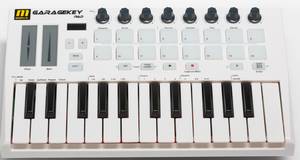
- Dimensions/Weight (cm/kg): 32-19-5/0.6
- 25 mini-keys (width: ??, length: ??): cheap ‘plastic hinge’ action, keys are prone to break off
- TRS-Midi (adapter to 5-pin included)
- 3 user-presets
- Pandamini (Groove): 8 pads, 4 pots, 4 faders // Orcamini (PAD): 16 pads, 8 pots. Pads have Aftertouch (!)
- controller midi-options: faders+pots: CC / pads: notes
- only one ‘global’ channel (no individual channels for encoders)
- pitch/mod ‘touch strips’
- Arpeggiator and Chord function
- Programming: ALL settings are set on the device (no editor aviable)
- Included software (with ‘MidiTech’): Miditech Free Software Bundle (VSTs, Samplers, Drum Computer etc)
- Novation Launchkey Mini MK3, Mk4, Mk4-37 (100 – 160 €)
The Launchkey series is hard focused to controll Ableton Live. Therefore only one ‘custom preset’ can be defined. Arturia has more flexiblity’ 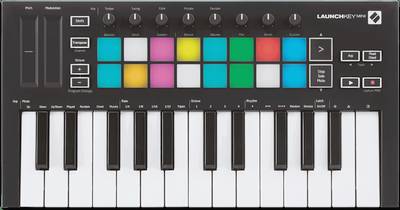
- Dimensions/Weight (cm/kg): 33-17-4/0.6 (mk3), 34-18-5/0.8 (mk4) ; 48-18-5/0.9 (mk4-37)
- 25 or 37 mini-keys (width: ??, length: ??)
- TRS-Midi (needs a Type-A adapter to 5-pin)
- only 1 ‘user-preset’ (‘custom mode’)
- 16 pads (mk4: with Aftertouch), 8 pots (Mk4: continous pots)
- individual channel assign to ‘keybed’, pads, pots
- controller midi-options: pots: CC / pads: CC,note,program-change (no combined bank-PC)
- programming: pads and pots must be programmed by editor (PC, Mac)
- pitch/mod ‘touch strips’
- Arpeggiator, Chord function
- Included software: Ableton Live Lite, XLN Studio-Grand, EP and String VI
- IK Multimedia IRig Keys 2 mini (100 €)
Doubtful for ‘live usage’: it is powered through ‘micro-usb’ socket which is very fragile for stage usage 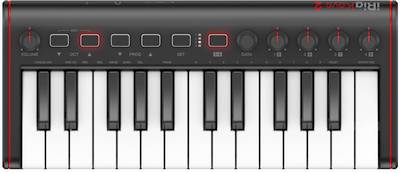
- Dimensions/Weight (cm/kg): 32 x 14 x 5
- 25 mini-keys (width: ??, length: ??)
- TRS-Midi (2.5mm – adapter to 5-pin included)
- 4 user-presets
- 2 banks with 4 knobs
- one single ‘global’ channel
- controller midi-options: pots: CC
- programming: on device (no editor available)
- Included software: SampleTank 4 SE
- AKAI Professional MPK mini Plus (170 €)
The Akai has 37 keys and a step-sequencer and ‘CV-out’ (for controlling analog synths) but also severe limitations:
You cannot attach VR and PC/tablet at the same time. Sending ‘bank-select’ (e.g. for loading VR GM2-sounds) requires “wasting” of 2 pads for msb and lsb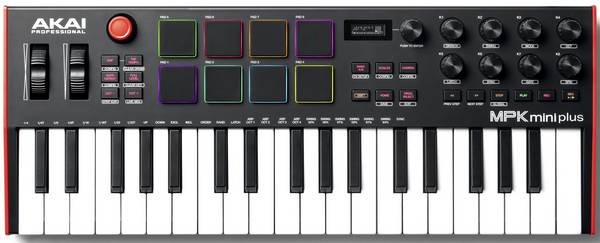
- Dimensions/Weight (cm/kg): 45-18-5/1.2
- 37 mini-keys (width: 19.4mm, length 80.4mm): a good and sturdy action (‘spring type’)
- 5-Pin-midi out and in WARNING: midi-out only works if the board is NOT connected to a tablet/PC !!
- 8 user-presets
- 2 banks of 8 pads, 1 bank of 8 pots
- individual channel assign for encoders/keys is limited to only 2 ‘global’ channels for keybed+encorders and pads
- controller midi-options:: pots: CC / pads: CC,note,program-change (no combined bank-PC)
- programming: ALL settings can be set on the device OR done by editor (PC, Mac)
- pitch/mod ‘wheels’ plus ‘xy’-wobble-stick
- Step Sequencer, Arpeggiator, Chord function
- Included software: Ableton Live Lite, Akai MPC Beat, Hybrid-3 virtual synth